
YOUR JOURNEY CONTINUES
A GRADUATE LEADERSHIP PROGRAM FOR TCLA ALUMNI
ALUMNI 2 AMBASSADOR
Sponsored by

You graduated from the Transit Citizen Leadership Academy TCLA. Now what?
The Alumni 2 Ambassador (A2A) program was created for alumni who want to continue learning, ask bigger questions, and become a stronger voice for regional mobility in Middle Tennessee.
Transportation and the region are changing rapidly. Communities are growing. Investments are being made. Regional partnerships are becoming increasingly important. Conversations shaping the future of our region are happening right now.
A2A is your invitation to engage and lead change.
Designed as a graduate-level leadership experience, A2A combines executive leadership seminars, immersive field experiences, and meaningful discussion to help alumni move beyond understanding transportation systems to understanding how regional leaders create lasting change.
Whether your role is in business, government, planning, healthcare, education, engineering, nonprofit leadership, or community advocacy, A2A will deepen your understanding of how mobility connects people to opportunity and how informed leaders can help shape the future of our region.

TCLA Alumni from 2025 present a report and recommendations for improving regional transit to the Regional Transit Authority. L to R: Mayor Ken Moore, Franklin; Mayor Randall Hutto, Wilson County; Steve Bland, WeGo MTA/RTA; Cary Foust-Street; Brian Rose; Savannah Robertson; Becky Rehorn; Kaitlyn Jauch; Jubal Parris; Deanna Lambert; Jessica Dauphin; and Jason Fialkoff.
Why A2A?
The Transit Citizen Leadership Academy provides the foundation.
A2A builds upon it.
TCLA introduces transportation concepts, A2A explores the larger questions:
-
How do successful regions stay economically competitive?
-
What connects transportation, housing, workforce, healthcare, education, and economic development?
-
How do regional leaders build consensus and move big ideas into action?
-
What lessons can Middle Tennessee learn from communities across the country?
This is not another class.
It is an ongoing conversation among leaders committed to improving access to opportunity throughout Middle Tennessee.


A2A Program Components
The A2A program consists of four separate workshops: two virtual webinars and two in-person field experiences. You do not need to register for all four, but the in-person field experiences are limited and first come, first serve. See more detailed information, including dates and speakers below.
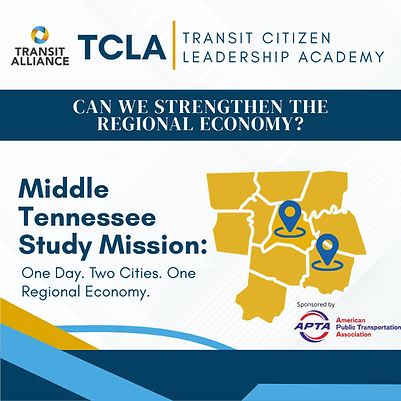
Middle Tennessee Study Mission
One day. Two cities. One regional economy.
PANELISTS:
-
Murat Arik, MTSU Business & Economic Research Center
-
Matthew Cushing, Metropolitan Planning Organization
-
TBA
Friday, October 16th
8:00 AM-4:15 PM
Don’t just study regional mobility. Experience it.
Travel Nashville to Murfreesboro with regional leaders to see firsthand how transportation connects people to jobs, education, healthcare, and opportunity. Along the way, explore what’s working, what’s missing, and what it will take to build a more connected Middle Tennessee.
Limited seating.
Field Experience: The Power of Regional Connections
SPEAKERS: TBA
DATE: TBA
Leadership Seminar II: Lessons from Nashville and Beyond
SPEAKER: TBA
DATE: TBA
Virtual Webinar
What can Middle Tennessee learn from successful transportation initiatives across the country?
This seminar examines how regions move from vision to implementation through leadership, coalition building, public engagement, funding, and long-term planning. Using Nashville's Choose How You Move program alongside national case studies, participants will explore practical lessons that can inform the future of regional mobility.
SPEAKER: ERIN HAFKENSCHIEL, THINKTN
Leadership Seminar I: Understanding Regional Connections Through Data
Thursday, September 10
10:30 AM - 11:30 AM
Virtual Webinar

A graduate-level discussion exploring how transportation, demographics, employment, housing, healthcare, education, and economic development intersect to shape regional mobility and opportunity.
Participants will examine data, national research, and emerging trends while learning how successful regions use information to make better long-term decisions.